The average mid-market manufacturer runs its business on three systems that rarely speak the same language. An ERP handles the money, the orders, and the master data. An MES governs what actually happens on the line — work orders, quality, traceability. And SCADA sits underneath, talking to the machines, sensors, and PLCs. Each was bought at a different time, from a different vendor, on a different technology generation. And each is now somewhere on the spectrum from “aging” to “actively holding us back.”
By 2026, the pressure to modernize all three at once is no longer theoretical — end-of-support deadlines, AI initiatives that need clean data, and tightening security expectations are converging on the same aging systems. The instinct, understandably, is to tackle them one at a time as budget allows. That instinct is the expensive mistake. When you approach manufacturing application modernization as three separate projects — a new ERP here, an MES refresh there, a SCADA upgrade whenever the OT team gets to it — you rebuild the very silos you were trying to escape, and you add a fresh layer of integration debt on top. This guide makes the case for the opposite: one coordinated migration strategy across ERP, MES, and SCADA, and a practical framework for running it without stopping production.
What manufacturing application modernization actually means
Manufacturing application modernization is the work of upgrading the software that runs a plant — ERP, MES, SCADA, and the constellation of custom applications around them — from aging, siloed, on-premise systems into maintainable, integrated, cloud-ready platforms. The emphasis matters: modernization is not the same as replacement. Done well, it preserves the business and process logic decades of operations depend on, while swapping out the technology underneath.
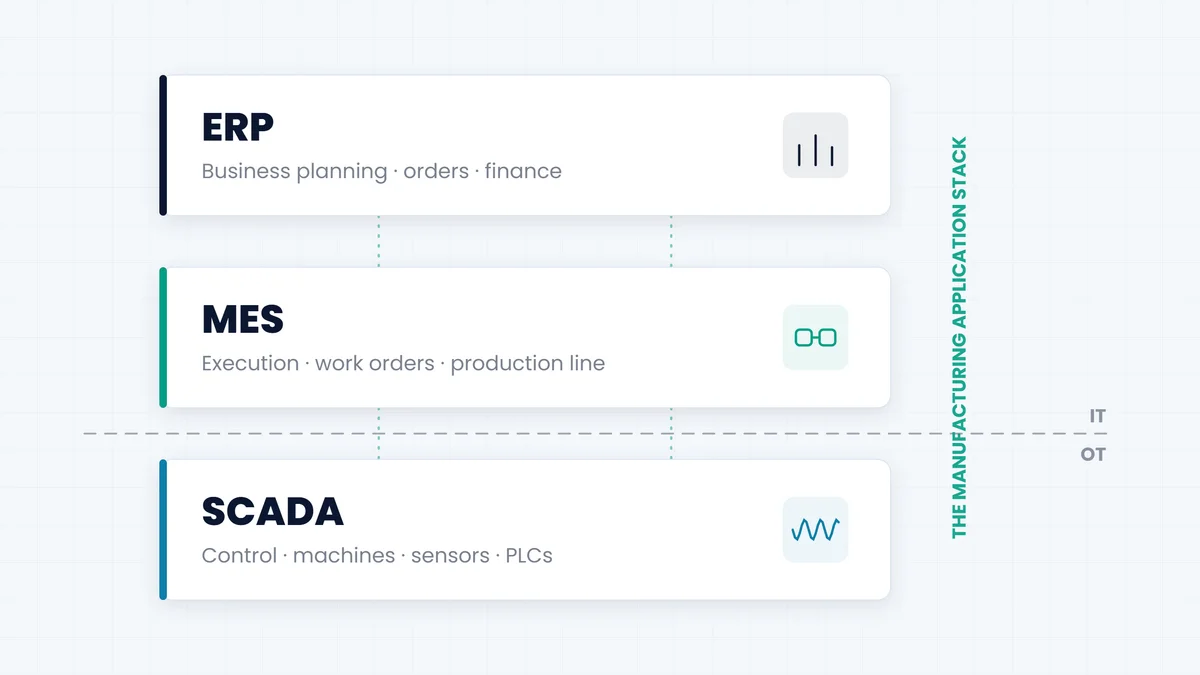
It helps to picture these systems as a stack, because that stack is exactly what a coordinated strategy has to move:
- ERP (the business layer): finance, procurement, inventory, orders. Usually the system with the most stakeholders and the most integrations hanging off it.
- MES (the execution layer): the translator between the business plan and the operations that carry it out — production tracking, quality, work orders, genealogy. The layer most manufacturers under-invest in, and the one where isolated ERP and SCADA projects tend to collide.
- SCADA (the control layer): the operational-technology (OT) systems that read sensors and drive machines, where uptime and safety dominate every decision.
The reason application modernization in the manufacturing industry is harder than in most sectors is that this stack straddles the IT/OT divide. The top of it changes on IT timelines — weeks, features, data. The bottom changes on OT timelines — years, uptime, safety cases. A modernization plan that ignores that boundary is a plan that breaks at the boundary.
Why modernization can’t wait in 2026
Manufacturers have deferred this work for years, and for a while that was defensible. It isn’t anymore. Several pressures have arrived at once:
- End-of-support is now a hard date, not a warning. Older .NET Framework versions, Windows Server releases, and on-premise platforms are aging out of vendor support, which turns “technical debt” into a security and compliance liability with a deadline attached.
- AI and analytics need a data foundation you don’t have yet. Predictive maintenance, quality vision, demand forecasting — all of it depends on governed, connected data. You cannot bolt AI onto systems that can’t cleanly share what they know. Modernization is the prerequisite, not a parallel track.
- The people who understand the old stack are retiring. Institutional knowledge embedded in legacy code and undocumented integrations is walking out the door. Every year of delay makes the eventual migration harder and more expensive.
- Security and audit expectations keep rising. Customers, insurers, and auditors increasingly expect production software to meet a baseline that aging platforms simply cannot.
- The economics have flipped. On-premise systems that once looked “paid for” now carry rising maintenance, licensing, and downtime costs that a modern, cloud-ready platform avoids.
None of these is unique to any one system. They apply to ERP, MES, and SCADA simultaneously — which is the first hint that treating the three as separate programs is the wrong shape for the problem.
The silo trap: modernizing ERP, MES, and SCADA in isolation
Here is how it usually goes wrong. Finance sponsors an ERP upgrade because that is where the budget and the board attention are. Operations, separately, funds an MES refresh. The OT team, on its own cycle and its own risk tolerance, plans a SCADA migration for “sometime next year.” Three teams, three vendors, three timelines, three definitions of “done.”
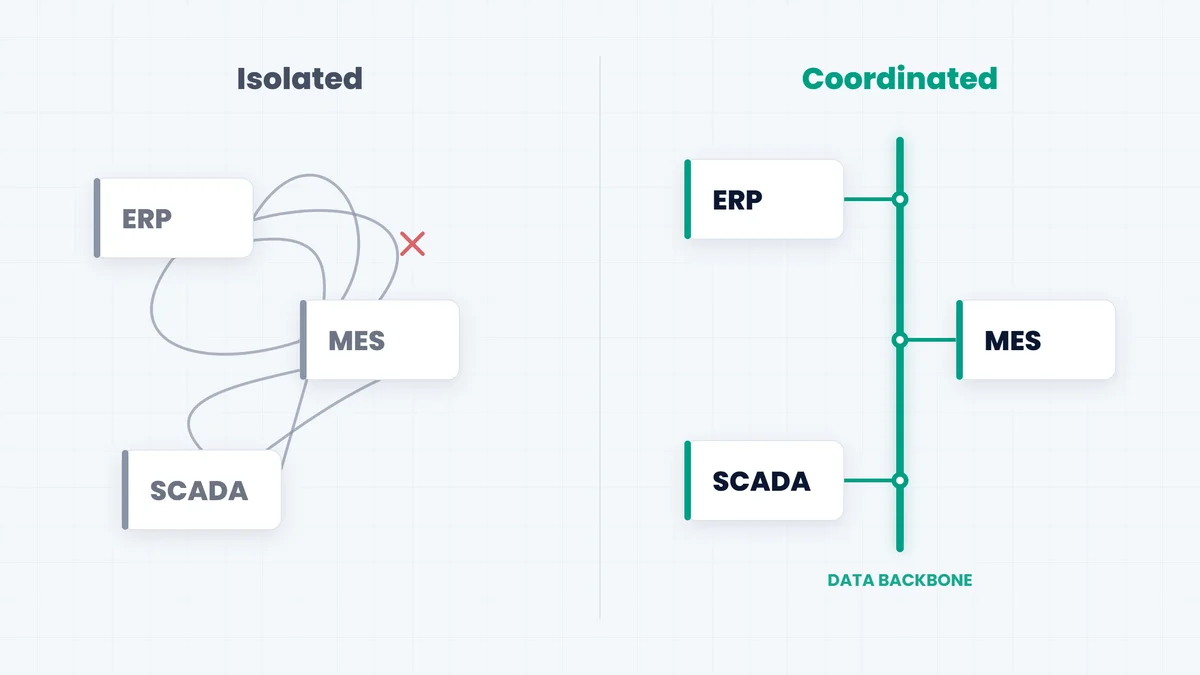
The result is predictable:
- Integration debt multiplies. Every system modernized in isolation needs a new bridge to the others. Those bridges are built twice — once against the old neighbour, once against the new one — and each is a bespoke maintenance burden that compounds.
- Data drifts apart. When ERP, MES, and SCADA are migrated on separate schedules, master data, units, and identifiers fall out of sync. The single source of truth you were promised becomes three sources arguing with each other.
- Downtime risk stacks up. Three uncoordinated cutovers mean three windows where the plant is exposed — and no single team owns the seams between them.
- Cost is duplicated. Discovery, integration design, testing, and change management get paid for three times instead of once, because nobody scoped the systems as a whole.
This is the trap at the heart of legacy app migration in the manufacturing industry: the systems are interdependent, but the projects are not. You end up with three modern systems that are just as disconnected as the three legacy ones they replaced — only now you’ve paid a premium for the privilege.
The case for a coordinated migration strategy
A coordinated strategy starts from a different premise: ERP, MES, and SCADA are one interconnected system with one set of data flows, so they should be modernized against one roadmap and one integration backbone.
That doesn’t mean modernizing everything simultaneously — that would be reckless. It means one plan that sequences the work, one team accountable for the seams between systems, and one shared backbone that every system connects to as it lands. The payoff is concrete:
- IT/OT convergence becomes deliberate, not accidental. The boundary between business systems and production operations is designed once, correctly, instead of rediscovered three times under pressure.
- A shared data backbone replaces point-to-point integrations. ERP, MES, and SCADA publish to and consume from a governed layer, which is also the foundation your future analytics and AI work will need.
- Sequencing de-risks the whole program. Each wave is planned to make the next one safer and cheaper, rather than each project optimizing for itself and externalizing the integration cost.
- Change management happens once. Operators, planners, and engineers are brought through a coherent transition instead of three disruptive ones.
Coordinated does not mean slow. It means the effort you were going to spend three times, spent once, in the right order.
A coordinated framework for manufacturing application modernization
Across the manufacturing modernization work we’ve delivered, the programs that succeed follow the same shape. Six steps, one program.
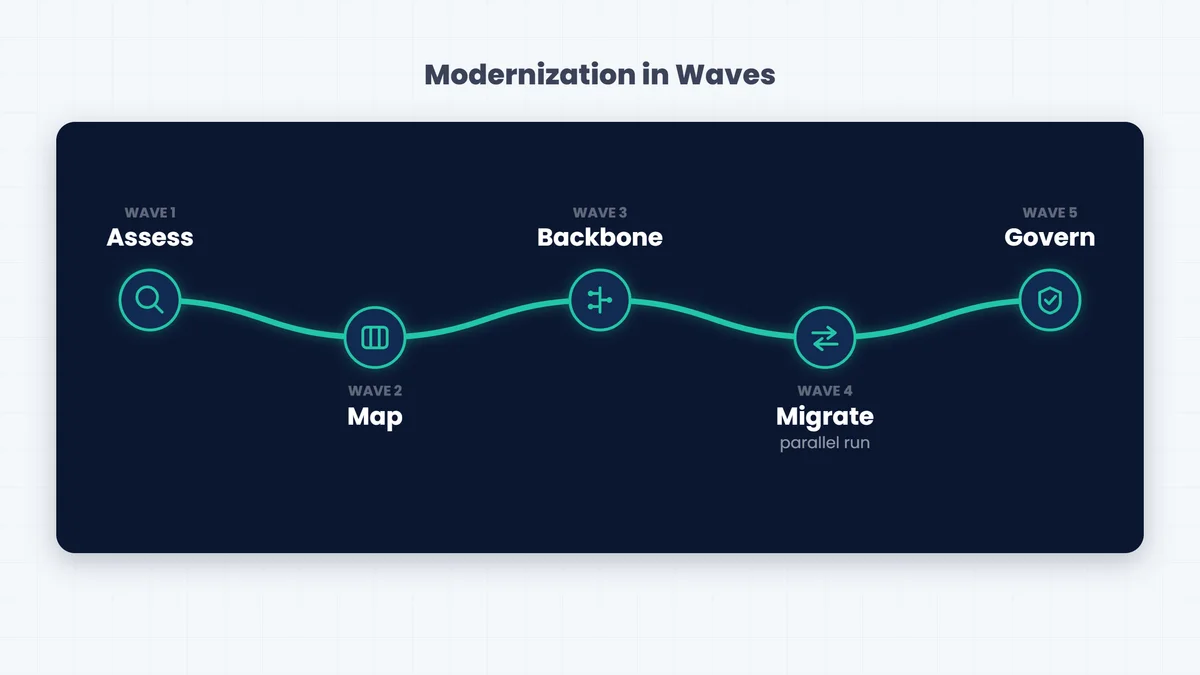
1. Assess everything, not one system
Inventory everything — ERP, MES, SCADA, and every custom application and integration around them. Score each on business risk, end-of-support exposure, and how tightly it’s coupled to the rest. The goal of this phase is a single, shared map — not a business case for one upgrade.
2. Map dependencies and IT/OT data flows
Before touching any system, document how data actually moves between the business layer and the production line — including the logic buried in database jobs, triggers, and undocumented middleware. This is the step isolated projects skip, and it’s exactly where they later collide.
3. Sequence the migration in risk-based waves
Order the work so each wave de-risks the next. Start where end-of-support or a blocking dependency forces the timeline, and keep operations running the entire time. A wave-based plan is what lets you show progress to the board without freezing operations.
4. Build the integration and data backbone first
Stand up the shared APIs, messaging, and governed data layer before migrating individual systems. When ERP, MES, and SCADA each connect to one backbone instead of to each other point-to-point, you eliminate the integration debt that sinks isolated programs — and you build the data foundation your analytics roadmap needs anyway.
5. Migrate with parallel run and controlled cutover
Run old and new side by side, reconcile daily, and cut over module by module with a rollback path. Production should never depend on an untested big-bang release. This is the discipline that lets a plant replace a core system without losing a shift.
6. Govern, secure, and iterate
Carry security, access control, and audit into the modern stack from day one rather than bolting them on later. Then keep improving — the point of modernization is a foundation that is finally built to change.
Mapping your ERP, MES, and SCADA systems?
Bring us your systems, integrations, and end-of-support dates. We'll help you sequence a coordinated modernization roadmap — highest-risk system first, no frozen operations.
Sequencing ERP, MES, and SCADA: what to migrate first
The question every CTO asks is “which one first?” — and the honest answer is that it depends on where risk and pain concentrate. But there are reliable patterns.
Lead with the backbone, not a system. The integration and data layer (step four) should almost always come first, because every subsequent migration is safer and cheaper once systems connect to a shared foundation instead of to each other.
Then modernize the layer that’s blocking the others. Frequently that’s the MES tier, because it sits between the business systems and production and is where an isolated ERP or SCADA effort tends to break. Modernizing the execution layer often unlocks the most value fastest.
Treat SCADA and the OT layer with the most conservatism. Control systems carry uptime and safety constraints that IT systems don’t. They usually move last and slowest, in tightly controlled windows — which is precisely why they must be in the plan from the start, not discovered at the end.
Whatever the order, migrate in parallel run. No single system should cut over in a big bang. This is the practical core of legacy app migration in the manufacturing industry: keep the old system live until the new one has earned the switch.
Also read
A cement manufacturer replaced a core legacy plant platform on exactly this model — phased, parallel-run, and live before the vendor’s AMC renewal, with zero plant downtime:
Choosing an app modernization partner
Most manufacturers don’t run a program this size alone — and the choice of partner determines whether you get a coordinated environment or three more silos. When you evaluate app modernization service providers, the differences that matter are rarely on the capability slide; they show up in how the partner talks about the plant.
Green flag — they show manufacturing case studies where a core system was cut over without stopping production, and they talk about the IT/OT boundary unprompted.
Red flag — generic “digital transformation” decks with no plant-floor specifics, and a rip-and-replace plan that ignores your existing data and integrations.
The traits worth insisting on: genuine industrial domain depth rather than enterprise patterns retrofitted to a factory; a track record of phased migration under live operational load; real integration experience across the IT/OT divide; and the discipline to reuse your production data and systems instead of forcing a clean-slate rebuild. That combination is exactly what we’ve built our application modernization practice around — modernizing legacy manufacturing systems into cloud-ready platforms while the plant keeps running.
Also read
For a code-level view of what re-platforming a legacy manufacturing application looks like — and the U.S. manufacturing modernization program behind it:
Coordinated modernization on a mid-market budget
For a mid-market manufacturer, the objection to all of this is usually financial: a coordinated program across ERP, MES, and SCADA sounds like a capital project you can’t get signed off in one go. The reassuring part is that “coordinated” describes the roadmap, not the invoice. You plan it as one program, then fund it wave by wave — each wave scoped to stand on its own business case, retire a specific end-of-support risk, or unlock a specific operational gain.
That framing also protects the budget from a common trap: buying overlapping application modernization solutions one system at a time. When three teams each procure their own tools and integrations, you pay for capability — plus discovery, plus testing — three times over. A single roadmap lets you buy once, reuse your existing data and systems, and avoid the duplicate integration spend that quietly doubles the cost of the uncoordinated approach.
Approached this way, manufacturing application modernization stops looking like a bet-the-plant capital event and starts looking like a sequence of self-justifying steps — each one smaller, safer, and cheaper than the isolated project it would otherwise be, and each one moving the whole operation toward a foundation that’s finally built to change.
The bottom line
The manufacturers who will pull ahead over the next few years aren’t the ones who modernized ERP, MES, or SCADA fastest. They’re the ones who modernized them together — as one connected system, on one roadmap, against one data backbone. Isolated upgrades feel safer because they’re smaller, but they quietly rebuild the silos and integration debt that made the old systems painful in the first place.
Manufacturing application modernization in 2026 is less a technology decision than a sequencing decision: assess the whole footprint, map the IT/OT data flows, build the backbone first, and migrate in waves that keep the plant running. Get the order right, and the hard part — replacing the systems your operation runs on — becomes a controlled, low-drama program instead of a bet-the-plant event.
Ready to modernize the systems your plant runs on?
Tell us about your ERP, MES, and SCADA systems and your cloud roadmap. We'll scope a coordinated, phased modernization plan that delivers value without disrupting production.