In most hospitals and clinic networks, the systems that matter most are also the oldest. The scheduling engine, the lab interface, the patient record — they were built years ago, they work well enough, and nobody wants to be the one who touches them. That is the trap. Healthcare application modernization is rarely delayed because leaders don’t see the cost of aging systems; it’s delayed because the risk of changing them feels worse than the risk of leaving them alone. This framework is built for that exact fear — a risk-first way to modernize HIS, LIS, and EMR systems without a single moment where a clinician loses access to accurate patient information.
Why healthcare modernization is a different problem
In most industries, a failed deployment means a bad day, a rollback, and an apology. In healthcare, the systems you’re modernizing sit between the clinician and the patient. When a Hospital Information System (HIS), a Laboratory Information System (LIS), or an Electronic Medical Record (EMR) goes down or returns the wrong data, the consequence isn’t a missed sale — it’s a delayed diagnosis or a care decision made on incomplete information.
That changes the engineering math. Three constraints make healthcare legacy apps harder to modernize than almost anything else:
- Patient safety is the real uptime requirement. These systems run 24/7, and “maintenance windows” are constrained by the fact that someone is always being treated.
- Data integrity is absolute. A longitudinal patient record that loses or corrupts history during a migration is worse than no migration at all.
- The environment is regulated and validated. HIPAA, HITECH, and interoperability standards like HL7 and FHIR aren’t optional features — they’re the conditions the system has to meet to be allowed to run.
So the question is never just “can we build a better system?” It’s “can we get from the old system to the better one without the transition itself becoming the risk?”
The cost of standing still versus the risk of doing it wrong
Leaving healthcare legacy apps untouched is not a neutral choice. Older platforms accumulate real, compounding cost: brittle integrations that break when anything around them changes, security gaps in software that no longer receives patches, scaling limits that throttle growth, and fragmented data that makes a unified patient view impossible. Each year, the system gets harder to change and more expensive to keep alive.
But the failure mode on the other side is just as real. A big-bang rewrite — switching the whole organization to a new platform on a single date — concentrates every risk into one moment. If the data migration is wrong, if an interface fails, if clinicians can’t navigate the new screens, it surfaces in production, with patients in the building.
The way out of that bind is not “modernize faster” or “modernize more carefully.” It’s to sequence the risk — to break modernization into steps where, at every point, care keeps running on something proven. That’s what a risk-first framework does.
The risk-first modernization framework
This is the framework we apply to app modernization in the healthcare industry. It is deliberately ordered: each step exists to retire a specific risk before the next step can introduce it.
-
Classify systems and data by patient-care risk. Before anything is rebuilt, rank every system and data set by a single question: what happens to patients if this fails? An appointment-reminder service and a medication-orders module are not the same risk class, and they shouldn’t get the same modernization path. The riskiest, most patient-critical systems get the most conservative approach.
-
Map clinical workflows before the data model. The most common mistake in healthcare modernization is starting with the database. Start instead with how care actually moves — admission to discharge, order to result, consultation to follow-up. The data model and architecture should follow the workflow, not the other way around. A system that’s technically clean but fights the way clinicians work will be worked around, and the modernization will have failed on the only metric that matters.
-
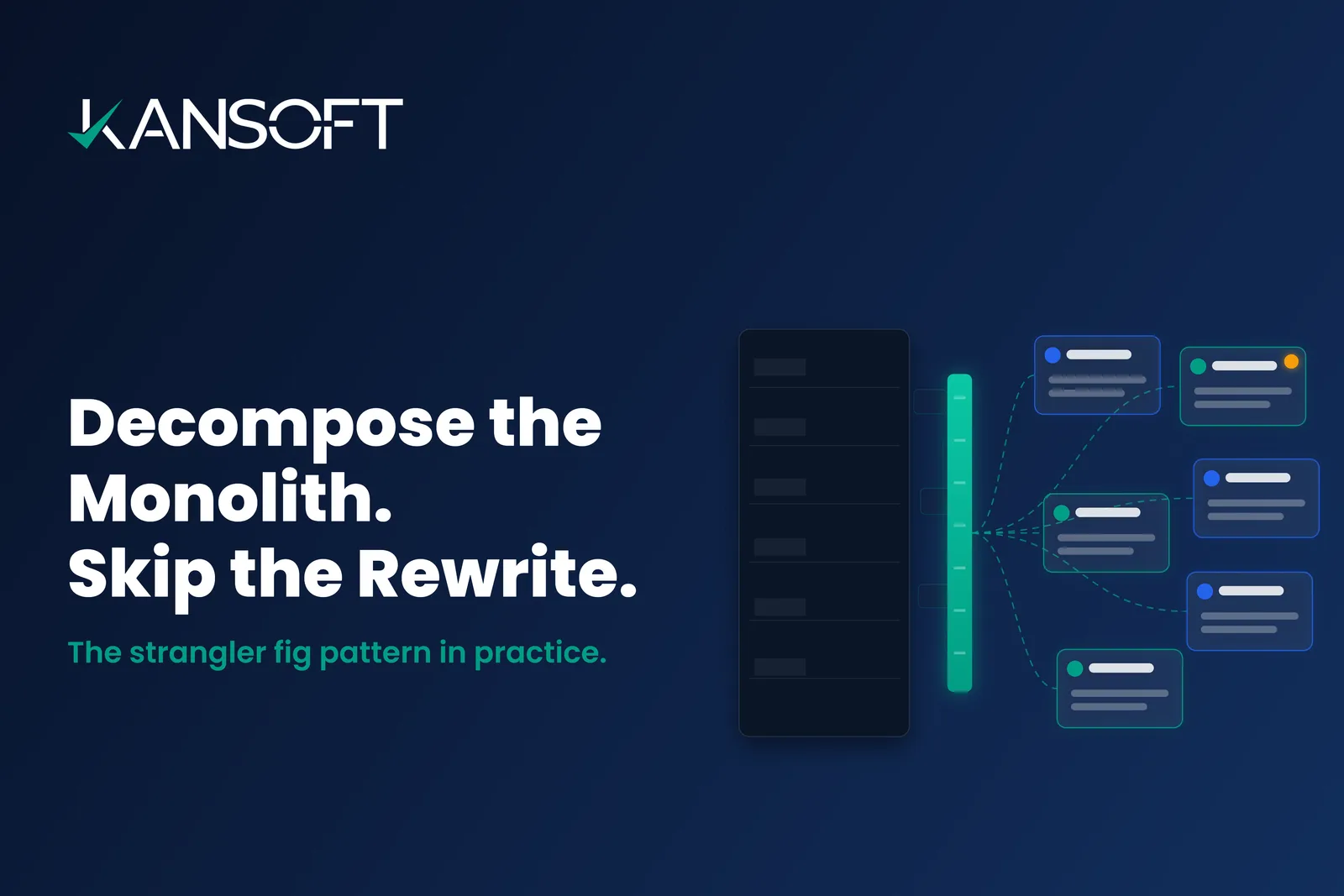
Choose an incremental path, not a big-bang rewrite. Use a strangler-fig pattern: stand up the modern system alongside the legacy one and move functionality across one module at a time, with both running in parallel. Care never depends on an untested switch-over, and any single step can be rolled back without touching the rest of the estate.
-
Build compliance and validation in from the start. PHI isolation, encryption in transit and at rest, role-based access control, and complete audit trails are architecture decisions made on day one — not a compliance review bolted on at the end. Capture validation evidence as you build, so the system is demonstrably compliant when it goes live, not retroactively justified.
-
Migrate clinical data with integrity. Move data with reconciliation and verification at every step, so the modernized record matches the source exactly. In clinical systems, “we’ll clean it up later” is not an option — the standard is zero data loss, proven, before a record is trusted in production.
-
Validate for clinical safety and roll out in stages. Test against real clinical scenarios, then roll out site by site — pilot one location, verify it, then expand. A network-wide cutover gives you no chance to catch a problem before it reaches everyone.
-
Monitor, support, and prove outcomes. Instrument the modernized system, support it in production, and measure against the pre-modernization baseline. The modernization isn’t done when it goes live — it’s done when you can show it reduced risk and improved how care is delivered.
Modernizing HIS, LIS, and EMR: where the risk actually sits
The framework is constant, but the risk profile differs sharply by system. Treating HIS, LIS, and EMR as one modernization program — with one approach and one timeline — is how programs go wrong. Here is how the three break down.
| Dimension | HIS — Hospital Information System | LIS — Laboratory Information System | EMR — Electronic Medical Record |
|---|---|---|---|
| What it runs | Admissions, scheduling, bed and resource management, billing | Test ordering, specimen tracking, results, instrument interfaces | Longitudinal patient record, clinical documentation, orders, care plans |
| Risk if it fails | Hospital operations stall — admissions and scheduling halt | Results delayed or mismatched — direct diagnostic safety risk | Clinicians lose access to patient history at the point of care |
| Hardest constraint | 24/7 availability and a web of downstream integrations | Stable instrument and HL7/FHIR interfaces; result integrity | Data integrity plus clinician adoption and interoperability |
| Lower-risk approach | Strangler-fig, module by module, with parallel running | Interface-first; keep HL7/FHIR contracts stable; dual-run results | Incremental migration with reconciliation; pilot per site |
| Modernize first when… | Integration sprawl and downtime are the operational pain | Aging middleware makes instrument interfaces brittle | Records are fragmented across multiple sites |
The pattern in that last row is what sequencing is about: you don’t modernize all three at once, and you don’t modernize them in an arbitrary order. You start where the patient-care risk of the current system is highest and the modernization approach is best understood.
Building healthcare regulation-compliant apps
For regulated clinical systems, compliance isn’t a layer you add — it’s a property the architecture either has or doesn’t. Modernizing healthcare legacy apps is an opportunity to fix this properly, because you’re rebuilding the foundation anyway.
Four things have to be designed in, not inspected in:
- PHI isolation. Protected health information needs hard boundaries — between environments, between tenants in a multi-site platform, and between roles. Without isolation, every other control is weaker.
- Audit trails. Who accessed which record, when, and what changed. In a HIPAA and HITECH environment, an audit trail that’s complete and tamper-evident is non-negotiable.
- Data integrity controls. Encryption in transit and at rest, plus reconciliation during migration so the modernized record is provably identical to the source.
- Interoperability. HL7 and FHIR are how clinical systems talk to each other and to instruments. Modernization that breaks those contracts breaks care delivery — so the interfaces are designed and tested first, not last.
This is the difference a domain-deep team makes. An engineer who understands HIPAA constraints makes different architecture decisions than one who treats healthcare as a generic CRUD application — and in a validated environment, those early decisions are the ones that are expensive to undo.
Proof: modernization without breaking care
A framework is only worth as much as what it produces. Two engagements show the risk-first approach applied to exactly these systems.
When Indira IVF — India’s largest IVF network, running 150+ clinics — needed to move off fragmented, clinic-by-clinic systems, the work was a textbook EMR and legacy app modernization problem: unify patient data without interrupting care at any location. We built a multi-tenant EMR platform with integrated billing and analytics on .NET Core and Angular, modernizing the legacy estate incrementally. The result was a 90% reduction in scheduling errors, 85% faster reporting, and 75% faster clinic onboarding — measured against the pre-modernization baseline. You can read the full Indira IVF EMR modernization case study for the architecture detail.
On the infrastructure side, Meddilink — a global IVF platform supporting 250+ clinics — needed its EMR to run on a foundation that could pass a HIPAA review. Its entire estate ran in a single AWS account with no separation between production and PHI. We established a HIPAA-compliant multi-account AWS landing zone with Terraform, environment isolation, and policy guardrails — built before workloads moved, exactly as step four of the framework prescribes. Provisioning dropped by 80%, automation reached 85%, and incidents fell 60%. The Meddilink HIPAA AWS architecture case study covers the governance model in full.
Both share the same shape: the patient-facing systems kept running while the foundation underneath them was rebuilt — and the outcomes were measured, not asserted.
Modernizing a clinical system you can't afford to take down?
See how our Application Modernization practice re-platforms HIS, LIS, and EMR systems without interrupting patient care.
Where to start
If you’re weighing a healthcare modernization program, the first move is not choosing a technology stack — it’s the risk classification in step one. Map your systems against the patient-care-risk question, identify which of HIS, LIS, or EMR carries the highest risk in its current state, and you’ll know where modernization buys you the most safety for the least exposure.
From there, the framework holds: workflows before data models, incremental over big-bang, compliance and validation built in, data migrated with integrity, rollout in stages, outcomes proven. None of it is about modernizing for its own sake. It’s about retiring the risk your legacy systems already carry — without taking on new risk in the process.
Want a risk assessment of your clinical systems?
Talk to our team and we'll map your HIS, LIS, and EMR estate against the risk-first framework — and show you where to start.