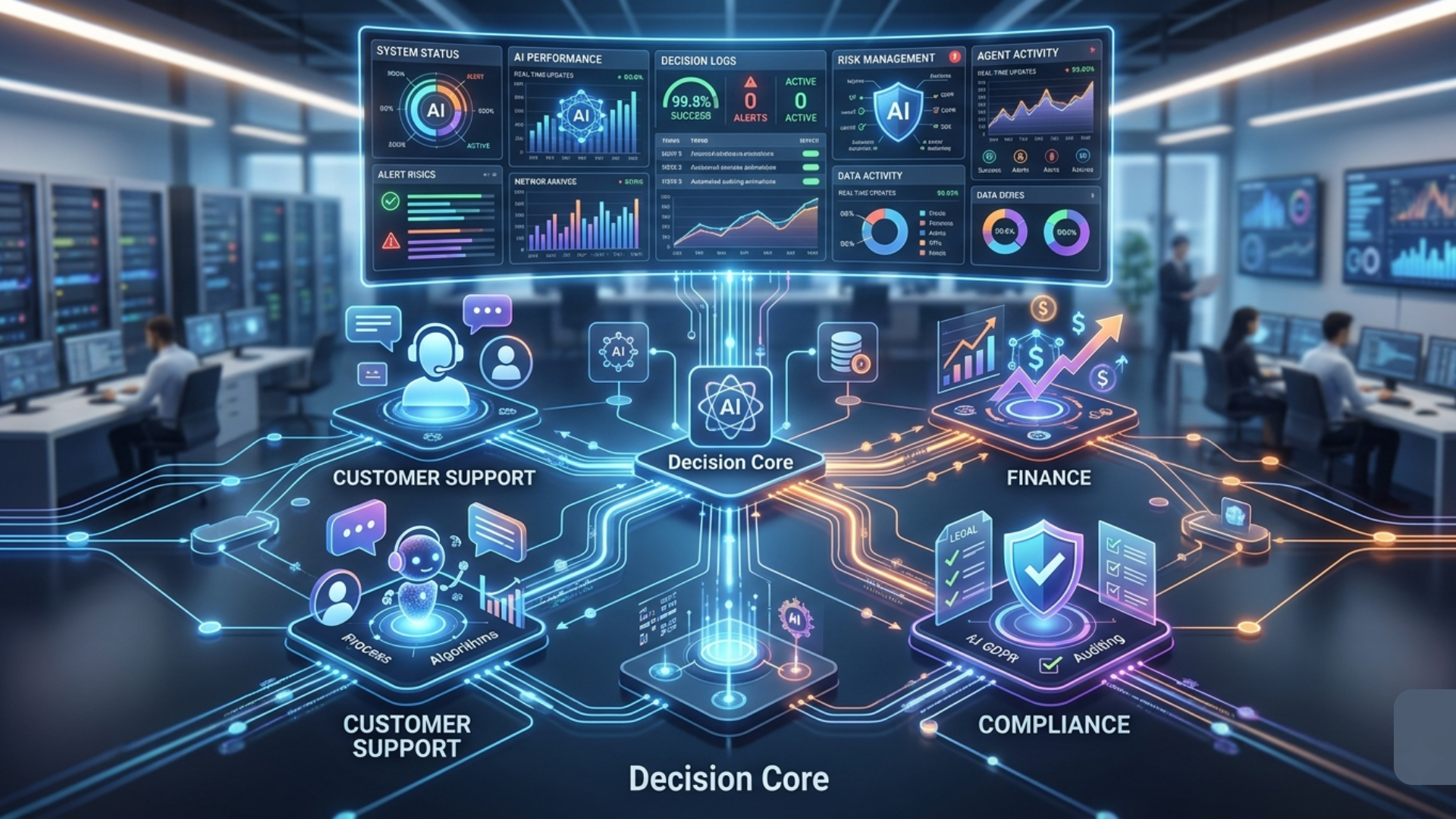
Most writing about agentic AI in software development describes a future: autonomous agents that will design, build, test, and ship software while humans supervise from a distance. The demos are impressive. The reality inside real engineering teams is more specific, more useful, and a lot more honest — and it’s what this piece is about.
Over the past year we’ve put agentic AI into real software delivery across a range of teams, stacks, and problem types. Some of it worked remarkably well. Some of it quietly wasted time. What emerged wasn’t a list of features to be excited about — it was a set of patterns that repeated regardless of the client, the language, or the tooling. Six of them are worth naming, because they predict, with surprising reliability, whether agentic AI will pay off or stall on a given piece of work.
This isn’t a tool roundup, and it deliberately avoids naming this month’s hot products — that list expires faster than the advice. It’s a field guide to the patterns underneath.
What “agentic” actually means in software delivery
Strip away the marketing and the distinction is simple. A conventional AI code assistant reacts: you type, it suggests the next line or block. An agentic system pursues a goal: you give it an objective — “upgrade this service to the new framework and keep the tests green” — and it plans the steps, reads and edits files across the codebase, runs the tests, reads the failures, and iterates until it’s done or stuck.
That shift from reacting to pursuing is the whole story. It’s what makes agentic AI powerful, and it’s also what makes it risky: the agent is acting on its own decisions, not just yours. Everything that follows comes back to managing that trade-off well.
Why most agentic-AI writing misses the point
The gap between a demo and a delivery is where most advice falls apart. A demo shows an agent building a to-do app from a sentence. A delivery involves a decade-old codebase, undocumented dependencies, a test suite of uneven quality, compliance constraints, and a team that has to live with whatever the agent leaves behind.
The teams that got value from agentic AI weren’t the ones with the best model access. They were the ones who understood where to point it — and that understanding is exactly what the following six patterns encode.
Pattern 1 — Narrow scope wins
The single strongest predictor of success was the width of the task.
Give an agent a bounded job with a checkable outcome — “generate unit tests for this module to 80% coverage,” “apply this codemod across the repo,” “port these endpoints to the new client” — and it performs like a fast, tireless engineer. Give it an open-ended brief — “build the reporting feature” — and it produces confident, plausible work that unravels on contact with real requirements.
The lesson isn’t “agents can’t do big things.” It’s that big things have to be decomposed into bounded steps before an agent touches them. The teams that succeeded spent their effort on scoping, not on prompting.
Pattern 2 — The human-in-the-loop gate is load-bearing
Every team that sustained results kept a review gate: the agent proposes, a human approves before anything merges. Every team that removed the gate to move faster regressed — not immediately, but within weeks, as small unreviewed errors compounded into rework and eroded trust.
The gate is not a temporary crutch for immature technology. It’s the mechanism that keeps accountability with a human when an autonomous system is making decisions. The productive framing we landed on: let the agent do the work, keep the human owning the judgment.
Pattern 3 — Context is the real product
Teams kept reaching for a “better model” when the actual bottleneck was context. An agent that can’t see the relevant code, conventions, domain rules, and prior decisions will confidently produce something that looks right and isn’t.
The unlock, repeatedly, was investing in retrieval over trusted context — the repository, internal docs, architecture notes, style guides — so the agent reasoned from how this system actually works rather than from generic training. The engagements that treated context engineering as the core work, rather than an afterthought, got dramatically better output from the same models.
Pattern 4 — Modernization is the sweet spot
If there was one category where agentic AI paid for itself fastest, it was legacy modernization: framework upgrades, language ports, dependency migrations, and large mechanical refactors — carried out under a test harness that could immediately tell right from wrong.
This work is a near-perfect fit for the technology: the changes are repetitive but tedious for humans, the scope is bounded per unit, and a passing test suite provides an objective, automatic reviewer. Teams facing a modernization backlog they’d been deferring for years found agents could clear it in a fraction of the time — provided the tests existed to keep the work honest. (This is also why so much of the highest-ROI agentic work sits next to a serious AI and agentic development practice rather than a general coding-assistant rollout.)
Pattern 5 — Beware agent sprawl
A failure mode that showed up as teams scaled adoption: too many agents and tools, uncoordinated. One for tests, one for reviews, one for docs, one for migrations — each configured differently, each with its own quirks, none aware of the others. The result was noise, duplicated effort, and confusion about which agent owned what.
The teams that recovered did two things: consolidated to a smaller set of well-understood agents, and introduced an orchestration layer so agents worked within a coordinated flow instead of a free-for-all. More autonomy without more coordination doesn’t scale — it just scales the mess.
Pattern 6 — If you don’t measure it, adoption reverts
The most quietly decisive pattern. Teams that measured — cycle time, review load, defect escape rate, before and after — could see where agentic AI helped and where it didn’t, doubled down on what worked, and sustained adoption. Teams that ran on vibes drifted back to old habits within a quarter, because there was nothing objective to defend the new way of working when it hit friction.
Measurement did something subtle beyond proving ROI: it kept adoption honest, surfacing the tasks where agents were actually slowing things down so teams could stop using them there. Enthusiasm starts adoption; measurement is what makes it stick.
Where agentic AI pays off vs. where it stalls
Pulling the patterns together, the dividing line is remarkably consistent:
| Pays off | Stalls |
|---|---|
| Bounded tasks with checkable outcomes | Open-ended, ambiguous briefs |
| Work backed by a strong test suite | Untested or poorly tested code |
| Rich, retrievable codebase context | Thin or missing context |
| Mechanical modernization and refactors | Novel feature design and product judgment |
| A human review gate in place | Unreviewed autonomous merges |
| Measured, coordinated adoption | Vibes-based, sprawling adoption |
None of this says agentic AI is limited. It says it’s directional — pointed at the right work, with the right guardrails, it compounds; pointed at the wrong work, it produces expensive-looking motion.
The non-negotiables: governance, security, oversight
Three guardrails came up in every engagement, and skipping any of them created problems that outweighed the productivity gains:
- Scoped permissions. Agents should have the narrowest tool and repository access that lets them do the job. Broad, standing access to production systems or credentials is an incident waiting to happen.
- Reviewable actions. Every change an agent makes should be inspectable and reversible — proposed as a diff or PR, not silently applied. Autonomy and auditability are not in tension; the second is what makes the first safe.
- Clear ownership. When an agent’s change causes a problem, a named human owns the fix and the learning. Accountability can’t be delegated to a system.
These aren’t bureaucracy — they’re the conditions under which autonomy is safe enough to be useful.
What this means for engineering leaders
If you lead an engineering organization, the practical read is straightforward:
- Start narrow and measurable. Pick one bounded, well-tested workflow, prove the pattern, and measure it before expanding. Don’t open with autonomous feature delivery.
- Invest in context and tests first. They’re the multipliers. The same agent produces very different results depending on what it can see and what can check it.
- Keep the review gate and the guardrails. They’re what let you move fast without moving recklessly.
- Expect roles to shift, not disappear. Your developers will spend less time on repetitive execution and more on scoping, reviewing, and architecture — which is where their judgment was always most valuable.
Agentic AI in software development isn’t a tool you switch on or a trend to wait out. It’s a capability that rewards teams who understand the patterns — and quietly penalizes those who don’t. The six above are the ones we’d want to know before starting, and now you do.
Exploring agentic AI for your engineering org?
Bring us a bounded, well-tested workflow and we'll help you prove the pattern — scoped, measured, and with the guardrails that make autonomy safe. From there, we scale what works.