
Across industries, enterprises are accelerating AI investments. New tools are being piloted, automation programs are expanding, and predictive intelligence is moving closer to core business operations. Yet a recurring pattern continues to appear: promising AI pilots succeed in isolation but struggle when organizations try to scale them across the enterprise.
The issue is rarely the AI model. In most cases, the real constraint lies in architecture, fragmented systems, inconsistent data environments, and infrastructure not designed for intelligent workloads. As organizations move deeper into 2026, a clear shift is happening: leaders are beginning transformation discussions not with tools, but with AI readiness assessment, enterprise architecture strategy, and long-term digital transformation architecture planning.
AI adoption is no longer simply a technology initiative. It is an architecture-readiness journey.
The Scaling Problem Most Enterprises Encounter
Many enterprises operate within environments built over years of incremental technology expansion. Systems were added as needs evolved, integrations were created reactively, and legacy platforms remained because replacing them was operationally risky. Over time, the result becomes a complex digital ecosystem that works for daily operations but struggles to support advanced transformation initiatives.
When AI programs begin, organizations often discover:
- Data required for models exists across multiple disconnected platforms
- Integration timelines grow longer than model development timelines
- Infrastructure struggles to handle high-performance workloads
- Governance processes are not designed for AI-scale data usage
AI initiatives begin as innovation programs but quickly turn into infrastructure and architecture modernization projects. This is why many enterprises are now starting transformation journeys with an AI readiness assessment before launching large-scale deployments.

What an AI Readiness Assessment Evaluates
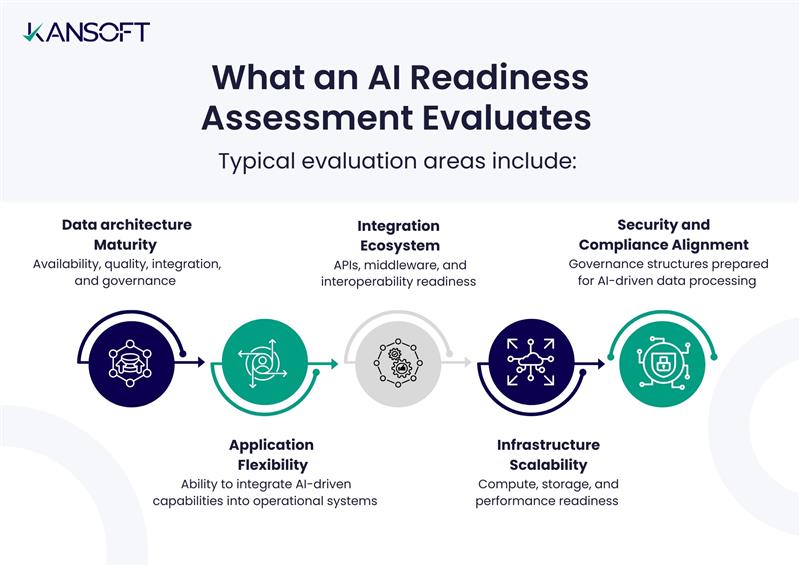
An effective readiness assessment focuses on the structural conditions that determine whether intelligent systems can scale. It does not evaluate only technology tools; it evaluates how well the enterprise environment supports intelligent operations.
Typical evaluation areas include:
- Data architecture maturity — availability, quality, integration, and governance
- Application flexibility — ability to integrate AI-driven capabilities into operational systems
- Integration ecosystem — APIs, middleware, and interoperability readiness
- Infrastructure scalability — compute, storage, and performance readiness
- Security and compliance alignment — governance structures prepared for AI-driven data processing
The outcome is clarity: what is ready, what requires modernization, and what must be prioritized to support enterprise-wide AI adoption.
Enterprise Architecture Strategy: The Transformation Anchor
A strong enterprise architecture strategy connects business priorities, technology platforms, and future capability development. Instead of pursuing isolated modernization projects, organizations create a unified blueprint that guides transformation decisions.
In an AI-led transformation, architecture strategy typically focuses on:
Capability-first design
Technology investments are aligned with business capabilities such as predictive operations, intelligent customer engagement, or automated decision support.
Platform-based thinking
Shared enterprise platforms replace fragmented applications, enabling faster deployment of digital and AI capabilities.
Incremental modernization
Legacy systems are modernized gradually through modular transformation; APIs, microservices, and phased system upgrades reduce operational risk.
Organizations that treat architecture as a strategic function rather than an IT activity consistently move faster in scaling innovation.
Digital Transformation Architecture: Enabling Operational Intelligence
While strategy defines direction, digital transformation architecture determines execution. It creates the operational foundation that allows AI capabilities to move beyond pilots into daily workflows.
Key elements of transformation-ready architecture include:
- Integrated enterprise data ecosystems supporting cross-functional analytics
- Standardized API and integration layers enabling system interoperability
- Composable application environments that allow rapid capability deployment
- Automation-ready process frameworks supporting intelligent decision-making
When these components are in place, AI solutions can integrate directly into enterprise workflows rather than functioning as isolated analytics tools.
Rethinking Enterprise IT Architecture for the AI Era
Traditional enterprise IT architecture prioritized stability and transaction processing. Today’s organizations require architectures that support adaptability, intelligence, and continuous evolution.
Modern enterprise IT environments are shifting toward:
- Service-oriented or microservices-based application structures
- Enterprise-wide data standards enabling unified analytics environments
- API-driven ecosystems that support real-time data exchange
- Embedded intelligence within operational systems rather than separate analytics layers
These shifts simplify integration complexity and make scaling intelligent capabilities significantly easier.
Cloud Architecture Strategy: Supporting Intelligent Workloads
AI transformation requires infrastructure capable of scaling dynamically while managing performance and cost efficiency. A forward-looking cloud architecture strategy provides the flexibility required for enterprise-wide intelligent workloads.
Effective strategies typically include:
- Hybrid and multi-cloud environments balancing compliance, performance, and flexibility
- Cloud-native platforms enable rapid deployment and automated scaling
- Cost governance frameworks ensure sustainable infrastructure usage
- Security-embedded architectures integrating compliance directly into infrastructure design
When cloud environments are aligned with transformation architecture, organizations gain the computational foundation required for scalable AI adoption.
Understanding Enterprise Architecture Maturity
Many enterprises benefit from viewing readiness through maturity stages. While every organization’s journey differs, architecture readiness often progresses through recognizable phases:
Stage 1 — Fragmented Systems
Disconnected applications, siloed data, and manual integrations dominate operations.
Stage 2 — Integrated Core
Key enterprise systems begin sharing data through structured integration frameworks.
Stage 3 — Platform-Based Enterprise
Enterprise platforms standardize processes, data flows, and operational capabilities.
Stage 4 — AI-Ready Architecture
Unified data environments, scalable infrastructure, and automated workflows enable enterprise-wide AI deployment.
Stage 5 — Intelligent Enterprise
AI capabilities become embedded across decision-making processes, operations, and customer engagement models.
Understanding the current stage helps organizations prioritize modernization investments more effectively.
Designing the Enterprise Digital Transformation Roadmap
A structured enterprise digital transformation roadmap ensures architecture improvements translate into measurable outcomes. Instead of launching isolated initiatives, organizations follow phased transformation programs aligned with long-term capability goals.
A practical roadmap often includes:
- Baseline architecture review — understanding current technology landscape and integration maturity
- Capability gap mapping — identifying architectural limitations impacting scalability
- Foundation modernization — strengthening data platforms, integration layers, and infrastructure
- Platform enablement — building enterprise platforms for scalable capability deployment
- Continuous architecture evolution — governance models ensuring technology evolves with business needs
Organizations that follow roadmap-driven transformation consistently reduce implementation risk while accelerating innovation timelines.
A Simple Enterprise AI Readiness Checklist
Enterprises beginning their readiness journey often start by evaluating a few foundational conditions:
- Is enterprise data accessible across departments through governed platforms?
- Are APIs and integration frameworks standardized across systems?
- Can infrastructure scale quickly for advanced analytics or AI workloads?
- Are governance and compliance frameworks prepared for expanded data usage?
- Is there a defined architecture roadmap supporting long-term transformation?
Download the Enterprise AI Readiness Checklist to evaluate where your organization currently stands and identify priority modernization areas.
From Readiness to Execution
Architecture readiness does not require immediate large-scale system replacement. In many cases, transformation begins with targeted improvements: integration standardization, data platform consolidation, or cloud architecture optimization. Over time, these foundational improvements create an environment where AI capabilities can scale naturally across business units.
Organizations that begin with structural readiness often discover that AI initiatives move faster, integration complexity decreases, and operational adoption improves significantly.
The 2026 Enterprise Reality
As AI adoption accelerates globally, the difference between experimentation and operational transformation is becoming clear. Enterprises that focus only on tools often struggle to scale results. Those that strengthen enterprise architecture strategy, modernize enterprise IT architecture, refine cloud architecture strategy, and follow a clear enterprise digital transformation roadmap create environments where innovation becomes repeatable and sustainable.
AI success is no longer defined by access to algorithms. It is defined by the strength of the architecture that supports it.
Start with an AI Readiness Assessment to understand your current architecture maturity, identify modernization priorities, and build a transformation roadmap designed for scalable intelligence.